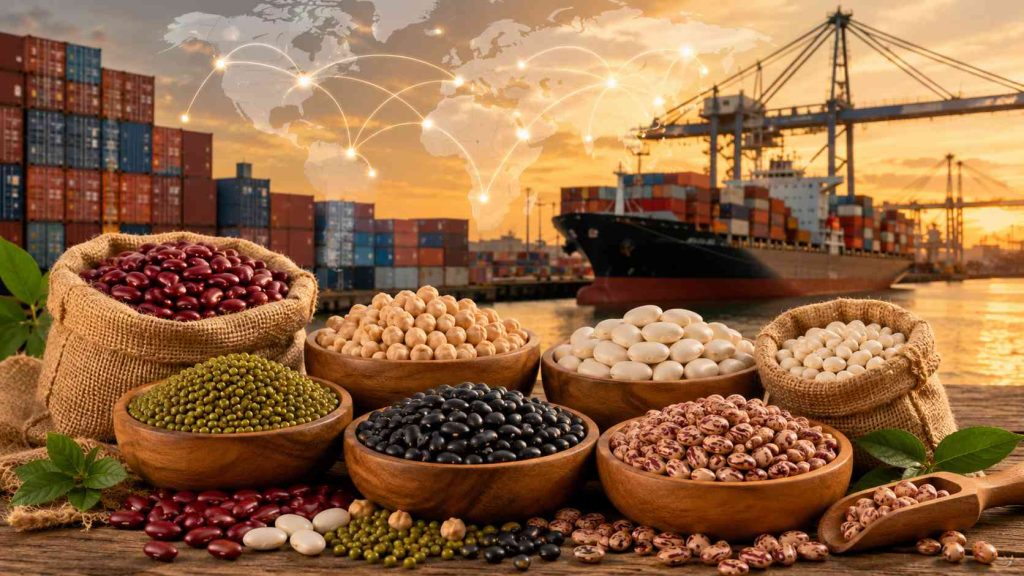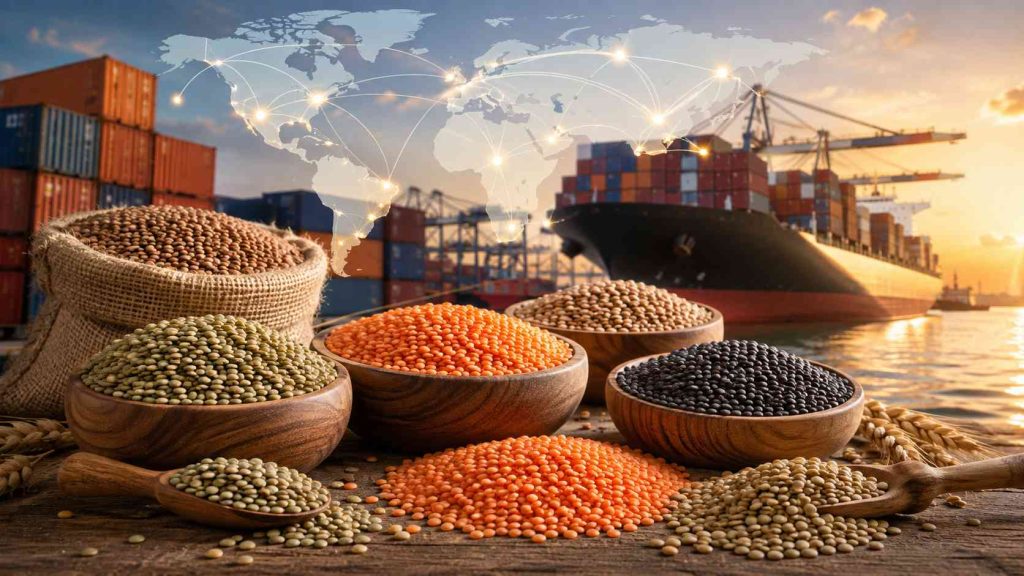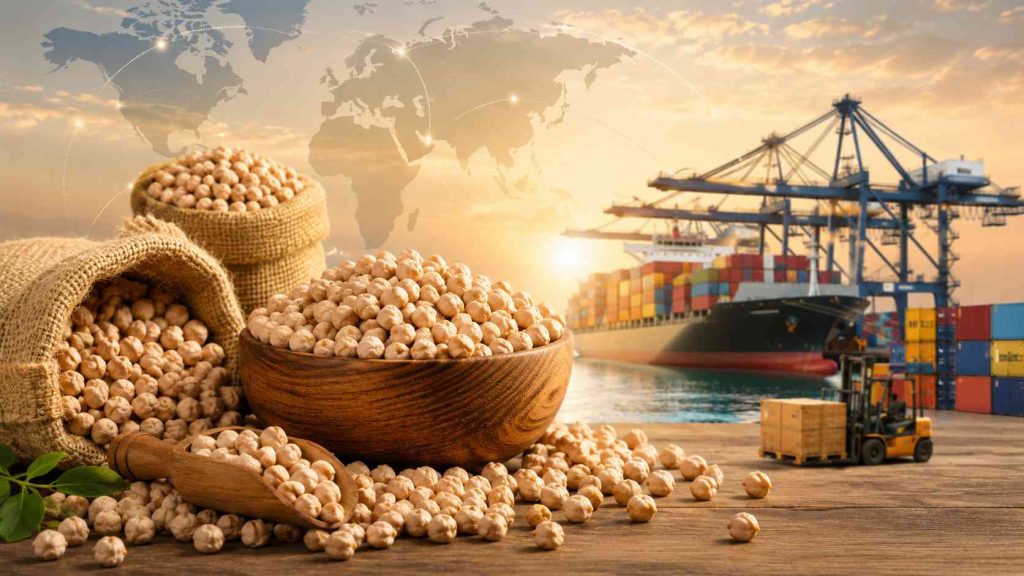

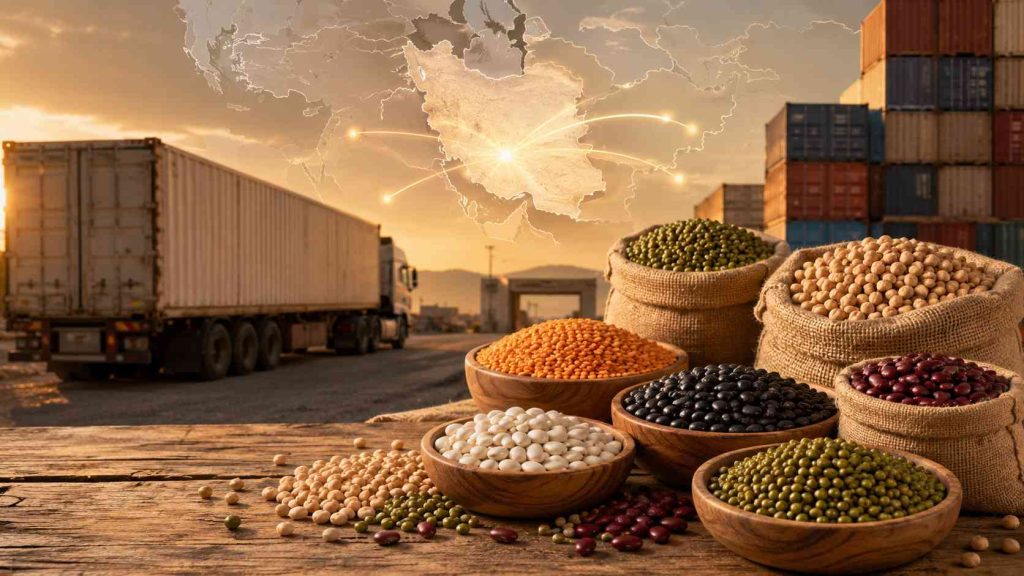
Iran occupies one of the most strategically important positions in the regional food trade of Western and Central Asia. Located between the Middle East, Central Asia, the Caucasus, and South Asia, the country has direct land borders with Iraq, Turkey, Armenia, Azerbaijan, Turkmenistan, Afghanistan, and Pakistan, while its southern coastline provides access to the Persian Gulf and the Gulf of Oman.
For the international pulse trade, this geographical position creates an important commercial advantage.
Chickpeas, lentils, beans, peas, and other pulses are widely consumed across nearly all of Iran’s neighboring markets. Some countries have substantial domestic production, while others depend heavily on imports or experience seasonal supply gaps.
Iran therefore has the potential to play several roles in the regional pulse supply chain: producer, processor, packer, trading center, sourcing base, and distribution point for neighboring markets.
For exporters and international buyers, understanding these advantages can help identify new opportunities for reliable and efficient regional sourcing.
Why Iran Is Strategically Located for Regional Pulse Trade
One of Iran’s strongest advantages is geography.
The country shares thousands of kilometers of land borders with seven countries and has direct access to important regional sea routes through the Persian Gulf and Gulf of Oman.
This creates potential access to several major consumer markets without requiring long intercontinental transportation routes.
Iran can reach:
- Iraq by road
- Turkey by road and rail connections
- Afghanistan by road
- Pakistan through southeastern trade corridors
- Armenia and the Caucasus through northwestern borders
- Azerbaijan through northern border crossings
- Turkmenistan and Central Asia through northeastern routes
- Gulf countries through southern ports
For agricultural commodities such as pulses, where logistics costs can significantly affect the final price, shorter transportation distances can become an important competitive advantage.
Iran as More Than a Pulse-Producing Country
When evaluating Iran’s potential in regional pulse trade, it is important not to look only at domestic agricultural production.
Iran can participate in the pulse supply chain through several different commercial models.
These include:
- Domestic production
- Collection from agricultural regions
- Cleaning and grading
- Color sorting
- Processing
- Splitting and polishing
- Packaging
- Bulk distribution
- Import and re-export where permitted
- Regional sourcing
- Consolidation of different pulse varieties
- Cross-border distribution
This means international buyers may be able to work with Iranian suppliers not only for products cultivated in Iran but also for products sourced through established regional and international supply networks.
This flexibility is especially useful when a buyer requires several pulse varieties in one sourcing program.
Iran’s Existing Role in Chickpea Trade
Chickpeas provide a useful example of Iran’s regional trade potential.
International trade data for 2024 show that Pakistan imported approximately 10.45 thousand tonnes of dried chickpeas from Iran, making it the largest reported destination for Iranian chickpeas that year.
Other buyers included:
- Uzbekistan
- Turkey
- European markets
- India
- Qatar
- Bahrain
- Kuwait
At the same time, Iran also received chickpea supplies from international markets, including India and Turkey.
This illustrates an important point about Iran’s potential role in pulse trade.
The country’s commercial advantage does not have to depend exclusively on being a major producer of every individual pulse variety. Iran can also function as part of a broader regional sourcing, processing, and redistribution network.
For buyers, this can provide greater flexibility in product origin, variety, seasonality, and pricing—provided that product origin, documentation, customs requirements, and applicable trade rules are clearly identified.
Why Neighboring Countries Represent Important Opportunities
The countries surrounding Iran include some of the world’s most active pulse-consuming markets.
Several of them already import substantial quantities of chickpeas, lentils, beans, and other dry pulses.
This creates opportunities for Iranian suppliers capable of meeting buyer requirements relating to:
- Quality
- Price
- Variety
- Size
- Packaging
- Logistics
- Documentation
- Delivery schedules
Each neighboring market, however, has different characteristics.
Iraq: One of the Most Attractive Regional Markets
Iraq is geographically one of the most accessible markets for Iranian exporters.
The two countries share a long land border, allowing goods to be transported through road-based commercial routes.
Pulses are widely used in Iraqi household consumption, restaurants, food-service businesses, wholesalers, and traditional food markets.
International trade data show considerable Iraqi demand for imported pulses.
For example, exporters reported supplying Iraq with more than 80 thousand tonnes of dried chickpeas in 2024, with Turkey and India representing the largest identified suppliers.
The scale of the lentil market is even larger. Turkey alone reported exports of approximately 218.8 thousand tonnes of dried lentils to Iraq in 2024, while India supplied an additional 18.5 thousand tonnes.
These figures demonstrate that Iraq already has an established international supply chain for pulses.
For Iranian suppliers, proximity may provide potential advantages in:
- Truck transportation
- Shorter supply routes
- Smaller shipment flexibility
- Faster replenishment
- Easier regional communication
- Competitive logistics for western Iran
Potential products include:
- Chickpeas
- Red lentils
- Green lentils
- White beans
- Red kidney beans
- Split peas
- Other common pulses
Potential Iraqi buyers include large importers, wholesalers, retail packers, supermarket distributors, food-service suppliers, and food-processing companies.
Turkey: Large Market, Processor, and Trading Hub
Turkey is one of the most important pulse markets in the region.
It functions simultaneously as:
- A producer
- An importer
- A processor
- A consumer
- A regional exporter
In 2024, Turkey imported approximately 279.6 thousand tonnes of dried chickpeas and around 646.5 thousand tonnes of dried lentils.
This makes Turkey particularly interesting for suppliers operating close to the Turkish market.
Iran and Turkey share a direct land border, and established customs crossings connect the two countries. Turkey’s Ministry of Trade identifies Gürbulak, Kapıköy, and Esendere among its border crossings with Iran.
Potential opportunities can include:
- Chickpeas
- Specialty chickpeas
- Beans
- Lentils
- Pulses for processing
- Products for regional redistribution
However, Turkey is also a highly competitive market with strong domestic processing and established relationships with major producing countries.
Iranian suppliers therefore need to compete through the right combination of product specification, freight advantage, availability, price, and commercial flexibility.
Pakistan: A Major Chickpea Market Next to Iran
Pakistan is another strategically important market.
It has a large population, strong pulse consumption, and substantial dependence on imported pulses.
In 2024, Pakistan was the world’s second-largest reported importer of dried chickpeas, purchasing approximately 409 thousand tonnes from international suppliers.
Pakistan also imported approximately 181 thousand tonnes of dried lentils during the same year.
Iran already has demonstrated trade links with this market.
Pakistan reported importing approximately 10.45 thousand tonnes of chickpeas from Iran in 2024, valued at more than US$8.2 million.
This provides evidence that a commercial supply route already exists between the two markets.
For Iranian pulse suppliers, Pakistan may be attractive for:
- Chickpeas
- Beans
- Lentils
- Bulk pulse shipments
- Wholesale distribution
However, the Pakistani market can be highly price-sensitive.
Suppliers need to closely evaluate:
- Local harvests
- International market prices
- Currency movements
- Import duties
- Border conditions
- Freight rates
- Buyer creditworthiness
- Payment arrangements
Afghanistan: Strong Geographic and Trading Connections
Afghanistan is one of the markets where Iran’s geographical position is especially important.
The two countries share a direct land border, while Iranian transport corridors and ports also provide Afghanistan with access to international trade routes.
Recent World Bank data show the significance of this commercial relationship.
During the first eight months of 2024, Iran became Afghanistan’s largest source of imports, accounting for approximately 30% of the country’s total imports. Food products represented an important part of Afghanistan’s overall import demand.
The World Bank continued to identify Iran as Afghanistan’s largest import source in the first half of FY2025, with a share of roughly 29%.
This demonstrates the importance of Iran as an established supply route for Afghan businesses.
For pulse suppliers, potential opportunities may exist in:
- Chickpeas
- Lentils
- Beans
- Split peas
- Retail pulse products
- Bulk commodities
Road access can provide flexibility for both large and relatively small commercial shipments.
Azerbaijan: Access to the Caucasus
Iran’s northern position also provides access to the Caucasus.
Azerbaijan represents a potential market for food and agricultural products, especially for suppliers based in northern and northwestern Iran.
Iranian food products already have an established history of trade with Azerbaijan. World Bank trade data identify Azerbaijan among Iran’s important food-product export destinations in earlier available reporting.
For pulse exporters, potential products may include:
- Beans
- Chickpeas
- Lentils
- Retail-packed pulses
- Specialty varieties
The opportunity is likely to depend more on specific buyer requirements and competitive pricing than on very large commodity volumes.
Armenia: A Smaller but Accessible Market
Armenia has a much smaller population than markets such as Iraq, Pakistan, or Turkey, but its direct border with Iran can create specialized trading opportunities.
For exporters, Armenia may be suitable for:
- Smaller commercial shipments
- Retail-packed pulses
- Specialty beans
- Chickpeas
- Lentils
- Food-service products
A smaller market should not automatically be considered unattractive.
In some cases, reduced logistics complexity and the possibility of building relationships with a smaller number of importers can create stable commercial opportunities.
Turkmenistan and Central Asian Connections
Iran’s northeastern border with Turkmenistan gives the country an important geographical connection to Central Asia.
This location may support both direct trade with Turkmenistan and wider regional distribution opportunities.
Central Asian countries produce some pulse varieties themselves, meaning Iran will not always have a cost advantage.
However, opportunities can arise when:
- A specific variety is unavailable locally
- Domestic harvests are insufficient
- Buyers require processed products
- Packaging requirements differ from local supply
- Seasonal price differences create trading opportunities
Iran has also demonstrated pulse trade links beyond its direct borders.
In 2024, Uzbekistan imported approximately 2.59 thousand tonnes of chickpeas from Iran, making it the second-largest reported destination for Iranian chickpeas after Pakistan.
This demonstrates Iran’s potential to serve markets beyond its immediate borders.
Gulf Markets: A Natural Extension of Iran’s Regional Reach
Although countries such as the UAE, Qatar, Kuwait, Bahrain, Oman, and Saudi Arabia do not share land borders with Iran, they are geographically close and can be accessed through maritime trade routes.
These markets often depend heavily on imported food products.
Chickpeas, lentils, beans, peas, and other pulses are widely consumed in Middle Eastern cuisine and by the large expatriate populations in Gulf countries.
Saudi Arabia alone imported more than 78 thousand tonnes of dried chickpeas in 2024.
Trade data also show that Iranian chickpeas reached markets such as:
- Qatar
- Bahrain
- Kuwait
during 2024.
This demonstrates that Iran’s potential regional market extends beyond land-border countries.
Iran’s Transportation Advantage
Transportation is one of the most important components of pulse pricing.
A difference of only a few dollars per tonne in freight costs can significantly influence competitiveness in high-volume commodity trade.
Iran has several geographical characteristics that can support regional distribution.
Western Road Corridors
Western Iran provides direct road access toward Iraq and Turkey.
This can be particularly useful for suppliers and warehouses located close to major western agricultural and commercial areas.
Eastern Connections
Eastern Iran connects with Afghanistan and Pakistan.
For Afghanistan, Iranian corridors have already become an important part of the country’s international trade network.
Northern Routes
Northern border crossings provide access to:
- Azerbaijan
- Armenia
- Turkmenistan
- Wider Caucasus and Central Asian routes
Southern Ports
Iran’s southern coastline provides access to maritime markets.
It can also support the movement of internationally sourced commodities into Iran before processing, distribution, or onward trade where legally and commercially permitted.
This combination of land and sea routes is one of Iran’s most important structural advantages.
Processing Can Be as Important as Production
International buyers often do not want agricultural products directly from the farm.
They require a product that meets precise commercial specifications.
This means Iran’s potential in pulse exports depends not only on cultivation but also on its ability to provide value-added processing.
Important services include:
- Cleaning
- Destoning
- Grading
- Size calibration
- Color sorting
- Splitting
- Polishing
- Quality control
- Laboratory testing
- Packaging
- Palletizing
- Export documentation
A processor that can transform mixed agricultural material into a standardized export product may create considerably more value than a supplier offering unprocessed commodities.
Flexible Packaging for Regional Markets
Different neighboring markets may require very different packaging formats.
Large importers may purchase pulses in bulk bags, while wholesalers and retailers may require smaller commercial packages.
Possible formats include:
- 25 kg bags
- 50 kg bags
- Large industrial bags
- Retail packaging
- Private-label packaging
- Customized buyer packaging
Providing several packaging options can help suppliers target both wholesale and retail channels.
What Products Could Iran Supply Regionally?
A diversified pulse supplier can potentially offer several product categories.
Chickpeas
Particularly relevant for:
- Pakistan
- Turkey
- Iraq
- Gulf countries
- Central Asia
Products can include different sizes and grades depending on buyer requirements.
Lentils
Potential markets include:
- Iraq
- Turkey
- Afghanistan
- Gulf markets
- Regional wholesalers
Red, green, and brown lentils may serve different commercial segments.
Beans
Potential products include:
- Red kidney beans
- White beans
- Pinto beans
- Black beans
- Small red beans
- Black-eyed peas
Different bean varieties may be sourced depending on season, origin, and buyer specifications.
Peas
Products such as:
- Green peas
- Dried peas
- Split peas
can create additional opportunities for wholesalers and food manufacturers.
The Importance of Regional Sourcing
One of the strongest business models for an Iranian pulse exporter may be a combination of domestic and international sourcing.
Agricultural production changes every year because of:
- Rainfall
- Temperature
- Planted area
- Crop yields
- Domestic demand
- International prices
Depending entirely on one origin can therefore create supply risks.
A professional regional supplier can potentially combine products from different approved origins and provide buyers with more stable availability.
However, transparency is essential.
The exporter should clearly identify:
- Country of origin
- Crop year
- Variety
- Product specification
- Processing location
- Packaging
- Certifications
- Laboratory results
Origin should never be misrepresented.
Why Proximity Matters to Pulse Buyers
Regional buyers do not always require the cheapest commodity available anywhere in the world.
They may value a supplier that can provide:
- Faster replenishment
- Shorter lead times
- Easier communication
- Smaller minimum orders
- More flexible packaging
- Faster samples
- Easier inspection
- Lower inventory requirements
- More responsive customer service
For example, an importer may prefer a nearby supplier even when the commodity price is slightly higher if the shorter supply chain reduces inventory and logistics risk.
This creates an opportunity for Iranian exporters to compete on service and reliability, rather than price alone.
Key Challenges That Must Be Managed
Iran’s geographical advantages do not eliminate the risks of international trade.
Professional exporters and buyers should carefully evaluate several factors.
Banking and Payment
International financial restrictions can affect payment methods and banking relationships.
Payment arrangements must therefore be reviewed carefully before each transaction.
Customs Regulations
Each destination country has its own rules concerning:
- Import permits
- Tariffs
- Product classification
- Certificates
- Labelling
- Food safety
These requirements can change.
Border Conditions
Land-border operations can occasionally be affected by:
- Congestion
- Security conditions
- Customs procedures
- Political developments
- Temporary closures
Exporters should maintain flexible logistics planning.
Agricultural Supply
Domestic production can vary significantly between seasons.
Reliable exporters need diversified sourcing strategies to maintain continuity.
Quality Consistency
Regional proximity cannot compensate for inconsistent product quality.
Buyers will continue working with a supplier only when each shipment meets the agreed specification.
Documentation for Professional Pulse Exports
Depending on destination and buyer requirements, documentation may include:
- Commercial Invoice
- Packing List
- Certificate of Origin
- Phytosanitary Certificate
- Certificate of Analysis
- Fumigation Certificate
- Weight Certificate
- Quality Certificate
- Transport documents
- Insurance documents
Exact documentation should always be confirmed before shipment.
Who Are the Potential Buyers?
Iranian pulse exporters can target several customer categories throughout the region.
Potential customers include:
- Pulse importers
- Commodity traders
- Wholesalers
- Food distributors
- Supermarket suppliers
- Retail packaging companies
- Canning companies
- Hummus manufacturers
- Food processors
- Restaurant suppliers
- Food-service distributors
- Private-label companies
Instead of offering the same product to every buyer, exporters should understand the requirements of each commercial segment.
A large wholesaler may prioritize price and availability, while a food manufacturer may focus on exact grain size, moisture, cooking performance, and consistency.
Building a Reliable Regional Supply Network
To become a long-term supplier to neighboring countries, Iranian exporters need to move beyond transactional sales.
A professional regional supply model should include:
- Reliable sourcing
- Multiple product options
- Consistent specifications
- Quality control
- Competitive pricing
- Transparent product origin
- Efficient packaging
- Professional documentation
- Reliable transportation
- Responsive communication
- Long-term availability
This can help transform Iran’s geographical advantage into a genuine commercial advantage.
Iran’s Opportunity as a Regional Pulse Hub
Iran is positioned between several of the world’s major food-consuming regions.
To the west are Iraq and Turkey.
To the east are Afghanistan and Pakistan.
To the north are Central Asia and the Caucasus.
To the south are the Persian Gulf markets.
Few countries have direct access to such a diverse collection of regional markets.
This gives Iran the potential to become not merely an exporter of locally produced pulses, but a broader regional center for sourcing, processing, packaging, and distribution.
The strongest opportunity may therefore come from combining three elements:
Agricultural supply + professional processing + geographical proximity.
When supported by quality control, transparent sourcing, competitive logistics, and professional export management, this combination can provide significant value for buyers throughout the region.
Conclusion
Iran has considerable potential to supply pulses to neighboring and nearby countries because of its strategic geographical position, agricultural base, processing capabilities, established regional trade relationships, and access to both land and maritime transportation routes.
Markets such as Iraq, Turkey, Pakistan, Afghanistan, Azerbaijan, Armenia, Turkmenistan, and the Gulf countries represent different types of opportunities.
Some offer high-volume demand.
Others provide logistical advantages, specialized buyer segments, or opportunities for flexible regional distribution.
The strongest long-term strategy is not necessarily to depend exclusively on domestic agricultural production. Instead, Iran can combine local production, international sourcing, processing, quality control, packaging, and efficient regional logistics to create a more resilient supply network.
For international buyers, this model can provide shorter supply chains, flexible sourcing options, competitive logistics, and access to a wide range of pulses from a strategically located regional partner.
Legumeland works with international buyers seeking reliable supplies of chickpeas, lentils, beans, peas, and other pulses for regional markets. Contact us to discuss your required product specifications, quantities, packaging, destination, and long-term sourcing requirements.